


IMD Insulation Monitoring Core | OCT621X: Establishing the First Line of Defense for High-Voltage Leakage Protection in Vehicles


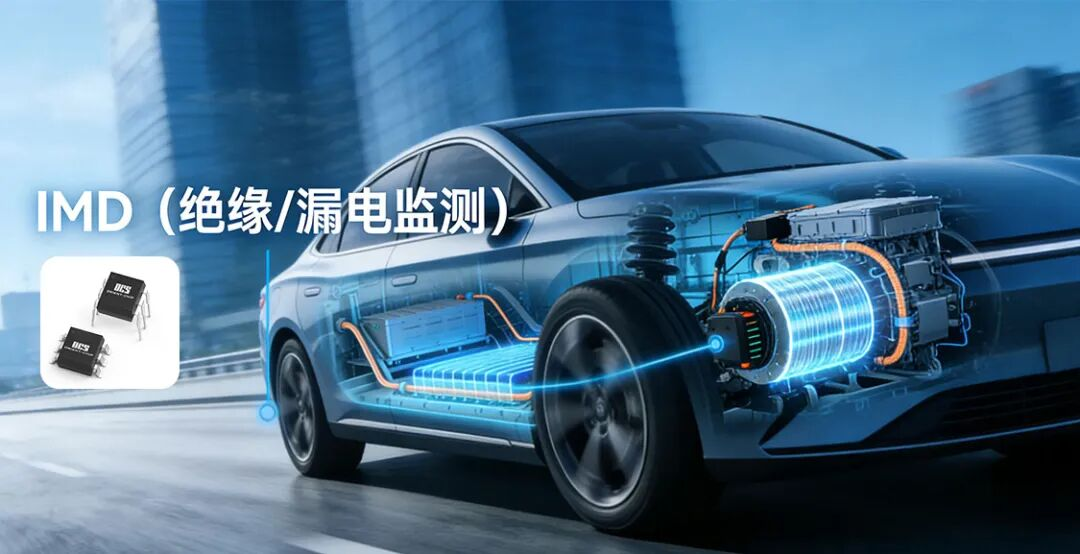
Insulation/leakage monitoring (IMD) of the high-voltage system in new energy vehicles is a critical component for ensuring driving safety, directly impacting the safety of both occupants and vehicle equipment. The IMD system requires real-time high-resistance monitoring of the insulation status between the high-voltage busbar and the vehicle chassis; the isolation switching of the test channel constitutes the core functionality of the IMD system. The OCT621X high-voltage optocoupler—characterized by ultra-low leakage current, high isolation, and low coupling capacitance—has become a dedicated device for switching IMD insulation/leakage monitoring channels, thereby establishing a robust safeguard for the high-voltage insulation safety of vehicles.
Core Advantages of the OCT621X for IMD Applications: To meet the stringent requirements of IMD insulation monitoring, the OCT621X achieves precise alignment across both parameter design and performance characteristics, making it the ideal choice for IMD channel switching: Low leakage current ensures high-impedance measurement accuracy: Turn-off leakage current ≤1μA (IF=0, VL=Max), eliminating interference from device leakage current in high-impedance IMD measurements and ensuring that insulation resistance results are authentic and reliable; High isolation provides a robust safety barrier: It offers an input-output isolation withstand voltage of 5000Vrms/1min; even if an insulation failure occurs on the high-voltage side, it effectively prevents high voltage from penetrating low-voltage components such as the MCU, thereby ensuring system safety; Low coupling capacitance reduces measurement crosstalk: The output capacitance of the OCT621X is optimized for withstand voltage; the typical value for the 600V sub-model is only 30pF. This low coupling capacitance effectively minimizes signal crosstalk between the high-voltage and low-voltage sides, eliminates measurement errors caused by crosstalk, and enhances IMD monitoring accuracy; Surge resistance and anti-interference capabilities ensure suitability for automotive operating conditions: It features excellent surge/ESD resistance, enabling it to withstand transient voltage spikes in automotive high-voltage systems and maintain stable operation in complex electromagnetic environments, thereby preventing false triggering or failure.
Application Design of OCT621X in IMD:
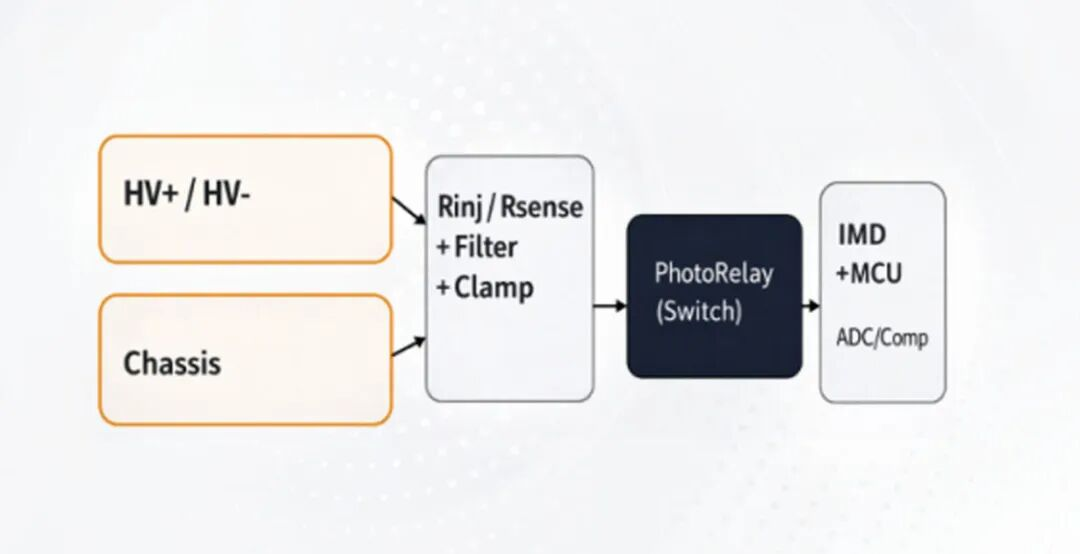
Within the IMD insulation monitoring circuit, the OCT621X serves as a solid-state switch connected in series with the test channel. One end connects to the high-voltage bus (HV+/HV-) and the detection resistor (Rinj/Rsense), while the other end connects to the MCU/ADC/comparator on the low-voltage control side. Together with the filtering circuit and the clamp protection circuit, it forms a complete insulation monitoring link. The OCT621X is responsible for switching between the IMD monitoring and self-test channels; it remains closed only during monitoring or self-testing, enabling the safe transmission of the high-voltage side's insulation status signal to the low-voltage side. It functions exclusively as a channel switching device and does not serve as an insulation failure protection or high-voltage disconnection device, thereby strictly adhering to the functional safety boundaries of the vehicle's high-voltage system. The OCT621X operates within a temperature range of-40~85°C, making it suitable for the vehicle's extreme temperature operating conditions. It has passed multiple UL/VDE/CQC certifications and complies with RoHS/ReaCH environmental requirements; its automotive-grade design and production standards ensure the long-term reliable operation of the IMD system. IMD insulation monitoring acts as the "safety guardian" of the vehicle's high-voltage system, while the OCT621X serves as the "core hub" for IMD channel switching. Leveraging its core advantages of ultra-low leakage current, high isolation, and low coupling capacitance, it ensures the precision and safety of insulation monitoring, making it the preferred supporting component for vehicle-based IMD systems.

