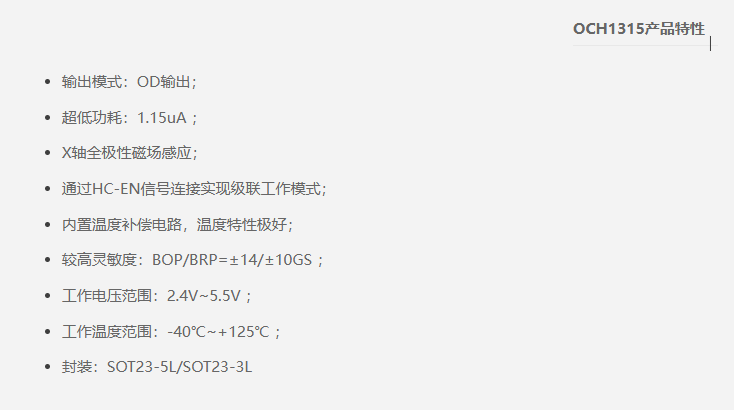
A Novel Liquid Level Detection Solution Based on Cascaded Magnetic Sensors—OCH1315


In liquid-level monitoring applications such as industrial storage tanks and water treatment, how to achieve multi-point liquid-level detection with a wide measurement range, high accuracy, and low power consumption at a low cost while ensuring system reliability has long been a challenge facing the industry.

Pain points of conventional solutions: Multiple Hall sensors operating simultaneously require mA-level operating currents, resulting in high power consumption and a heavy power supply load; using TMR sensors offers low power consumption but comes with high costs and poor noise immunity.
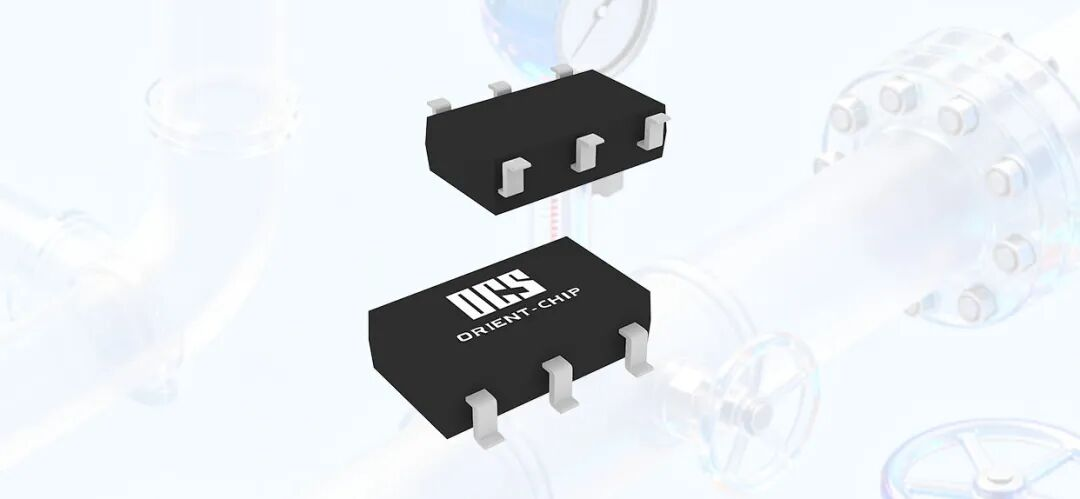
The OCH1315 introduces a new cascading approach: by cascading via the HC/EN pins, multiple sensors can be awakened sequentially and operated alternately, achieving ultra-low power consumption of 1.15 µA. This approach preserves the cost advantage of Hall sensors while enabling ultra-low power consumption; it also incorporates a fault-diagnosis mechanism to ensure system reliability and stability. The new cascading solution provided by the OCH1315 has been patented (CN221630841U).
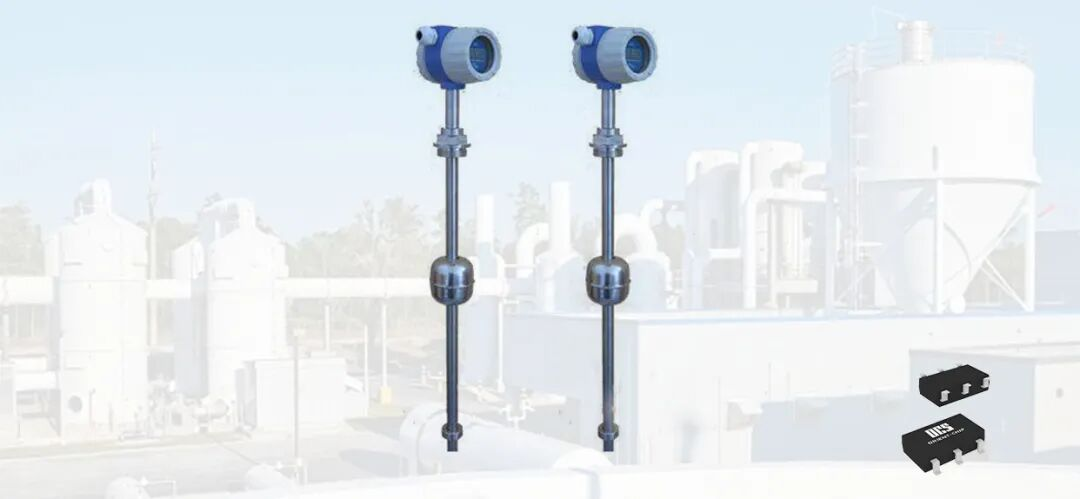
Key core technical advantages include the cascading operating mechanism and the fault-handling mechanism.
Core Operating Mechanism:
Multiple OCH1315 devices are connected via the HC-EN pins to form a cascaded operating chain;
1. The first sensor (Head) begins operation, while all other sensors enter sleep mode;
2. Once the Head sensor completes its operation, the next sensor is awakened via the HC pin;
3. This process continues sequentially; after the final sensor completes its operation, the chain is again awakened;
4. At any given moment, only one sensor in the entire system is actively operating.
Fault Handling Mechanism:
The cascaded architecture of OCH1315 incorporates a fault-handling mechanism that significantly enhances system reliability and stability, addressing various abnormal conditions such as failure, short-circuiting, or functional anomalies of any individual chip within the system. If a sensor fails, the circuit segments into two operational chains before and after the failure point, allowing both chains to continue operating without disrupting the overall system functionality; if a sensor exhibits functional anomalies and fails to output an HC signal, the next stage is forcibly awakened upon completion of its internal timing cycle to resume operation without affecting the system; if a sensor is short-circuited, current-limiting protection is triggered.