


Mastering Speed and Direction with a Single Core: The OCH1841 Speed and Direction Hall Sensor Redefines Motor Measurement and Control Experience


In applications involving brushless motors (BLDC), electric power steering (EPS), and rotary encoders, accurately determining "rotational speed (RPM)" and "motion direction (CW/CCW)" is an absolute necessity for implementing closed-loop control and state monitoring. Traditional solutions rely on dual sensors or complex magnetic-pole inference logic; these not only occupy PCB space but are also constrained by the stability of the air gap and magnetic-pole spacing. The OCH1841, introduced by Canrui Technology, leverages its unique vertical Hall + IMC sensing technology to provide speed (SP1) and direction (DIR) signals using a single chip, delivering "1+1>2" precise feedback to motor systems.
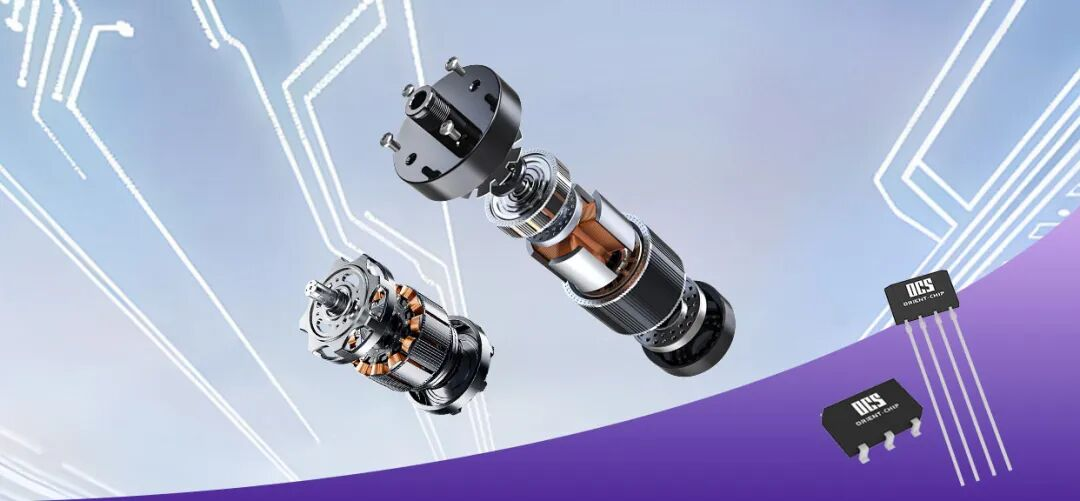
Four Key Challenges in Motor Control Field Applications: OCH1841 Addresses Each One
Spatial Challenge: Compact packaging enables dual-channel orthogonal operation in a single chip
In highly integrated PCB designs, placing two sensors simultaneously to obtain speed and direction signals not only consumes precious space but also makes the solution subject to assembly tolerances. OCH1841 utilizes a vertical Hall sensor combined with IMC technology to achieve dual-axis magnetic field sensing; the sensing axes are mutually perpendicular, providing a 90° phase difference by design (independent of the magnetic pole spacing and air gap). A single chip can therefore output both speed and direction signals, while the use of SOT23-5L or SIP-4L packaging significantly reduces the number of BOM components and the board footprint.
Thermal drift and wide-voltage challenge: stable across the full temperature range from –40 °C to 150 °C
From the low temperatures of northern winter to the high temperatures inside the engine compartment, the OCH1841 supports a wide operating voltage range of 2.7 V to 24 V, with an operating temperature range covering-40 °C to +150 °C, and incorporates a temperature compensation circuit. Whether facing significant temperature fluctuations or voltage fluctuations, the chip maintains stable switching points (BOP/BRP), ensuring reliable system feedback under extreme operating conditions.
Protection Rating: Comprehensive, industrial-grade robust protection
To meet the stringent challenges of automotive and industrial environments, the OCH1841 features AEC-Q100 automotive-grade certification and integrates output short-circuit protection, overvoltage (EOS) protection, and reverse power polarity protection. The chip employs an open-drain output, significantly enhancing the system's survivability and stability in electromagnetic interference environments.
Key Advantage: Robust Support for Automotive-Grade Hall Sensors
Dual-axis orthogonal sensing: Integrates vertical Hall sensing and IMC technology, providing direct output of speed and direction signals (SP1 & SP2/DIR).
Wide voltage/temperature range: Supports a wide voltage range of 2.7V ~ 24V and a temperature range of-40℃ ~ 150℃.
Latched output: Features built-in dynamic offset cancellation technology for precise detection of north–south magnetic pole switching.
Multi-layer hardware protection: Includes short-circuit protection, ESD protection, and reverse-polarity protection.
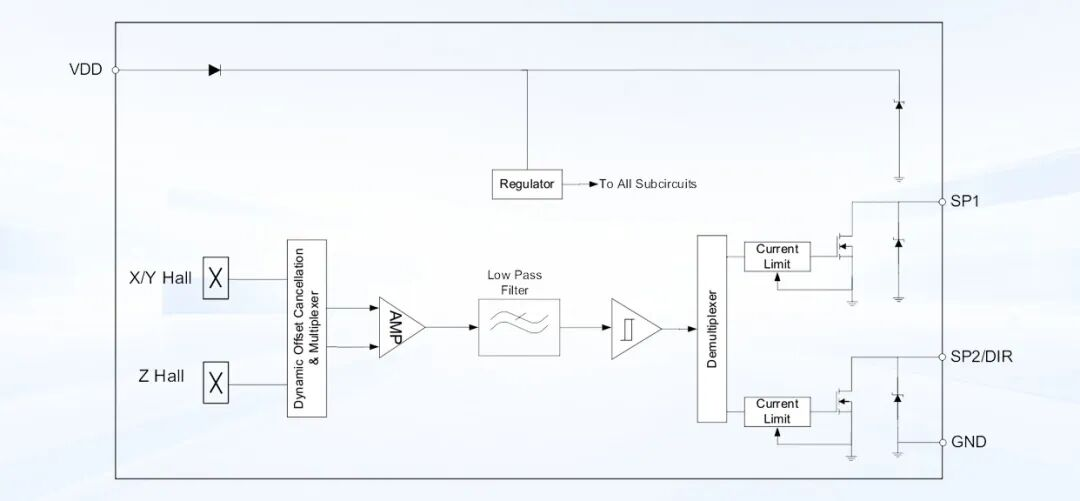
Block Diagram of OCH1841
Canrui Technology offers a variety of packaging and output options to meet the design requirements of diverse motors and encoders.
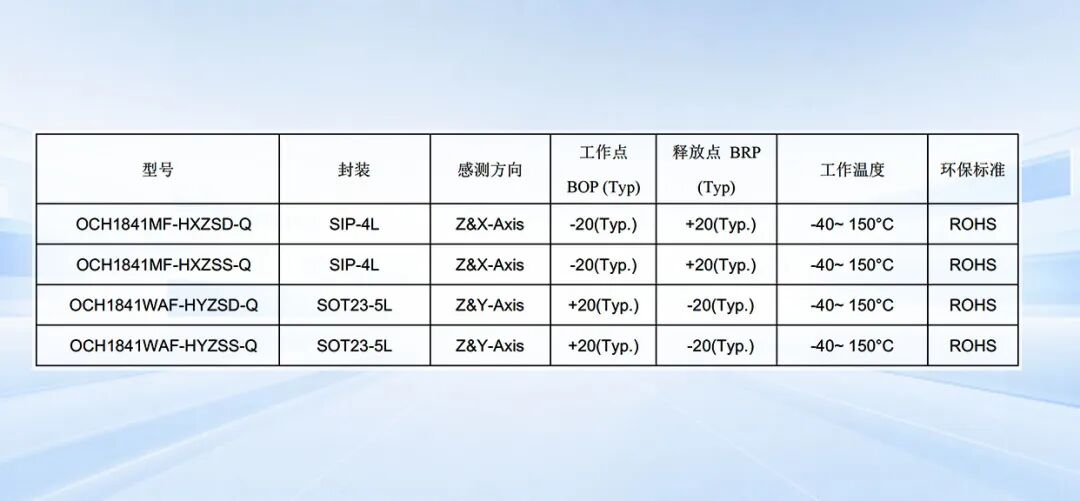
OCH1841 Model Selection Recommendation Table

